The Truth About Trolls
In 2004, Penny Arcade published a comic that was a criticism of behavior seen over voice chat in Unreal Tournament. The comic was titled “Green Blackboards (and other anomalies)”
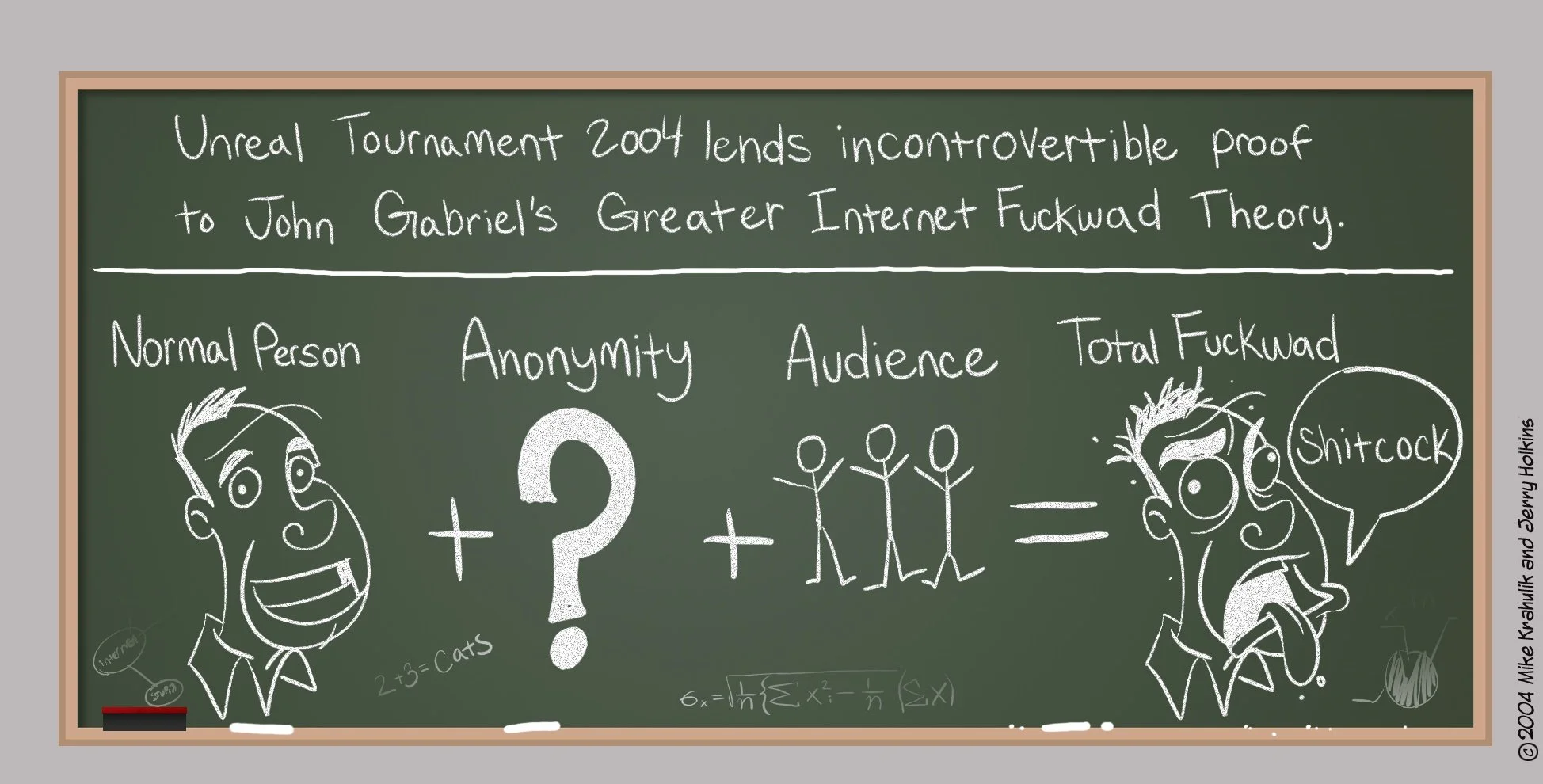
The comic gained traction across many communities addressing a general and growing concern around the act of online disinhibition. When one is anonymous or behind the barrier of a service or system, they tend to feel safer saying things that they otherwise would not in real life. Due to a general lack of real-life impacting consequences, this behavior is exacerbated and sometimes favored (both by the users and the algorithm) by certain spaces online. Given that this comic pre-dated social media as we know it now, we should have better prepared ourselves as the internet expanded to protect spaces intentionally.
Unfortunately, when you combine online disinhibition with empathy deficits and cultural elitism growing across nations - the effects become absolutely appalling to view. Comments sections have become absolute hellholes to navigate with creators regularly speaking to mental health challenges they are facing.
But what can be done to stop this from continuing?
We have to go a little bit deeper on different methodology they employ to understand potential solves.
The Troll Who Thinks They’re Doing You A Favor
This is the troll who believes that targeted, aggressive engagement is a conduit to changing someone’s perspective. They gain joy from causing distress, while being based in the belief that suppressing ideas is a disservice to a conversation. Rebuttals positioned purely for the purpose of rebuttal is a regular occurrence.
The Troll Who Thinks It is A Genre
Services like X or Reddit will favor community reaction as a signal for boosting content further up a feed. On Reddit, you will earn Karma from upvotes of your commentary, while X will monetarily reward you. Some commenters will purely post divisive perspectives to gain traction in these systems. Growing numbers of bots are trained in this manner to interact on social media spaces for the purpose of gaining attention (over being correct or welcomed in the conversation). Generating anger is a business and some believe solely in doing it for the LOLs.
The Troll Driven by Envy/Revenge
Due to the comparative nature of humankind, envy or revenge may be a driving factor for some trolls. With the “always-online” perceived nature of creators, the visibility of someone’s success will be front of mind for many passive scrollers in a given microcosm. The envy or disappointment in someone’s success will harbor resentment which can manifest into targeted trolling. When trolling occurs, it is always driven by malicious envy. Benign envy (inspirational/motivational) never results in trolling.
Revenge is another factor that will lead to engaged trolling. If a person feels they have been wronged in any way, shape or form, they could engage in revenge-focused behavior. The problem is that the individual on the other side of this conversation may or may not have done anything specific to trigger this reaction.
The Troll with Low Emotional Intelligence
Emotional intelligence typically creates a barrier against what can be seen as dark traits forming (Narcissism, Machiavellianism, Psychopathy) - and strengthens with age. A lack of emotional intelligence will result in these potential traits leading to trolling when provided with access to other humans. Given that the internet is readily available for many, individuals with these traits will naturally gravitate towards trolling.
The Troll Believing in Social Justice
Having a specific belief system, desire to maintain or establish a social norm, or set of morals that conflicts with another may lead to troll behaviors. This is where many individuals across a wide spectrum will find themselves participating in unconstructive debate or conversation spaces.
How do we lessen the trolling?
There is obviously no universal fix for all types of troll behavior online, and the “access to internet genie” is out of the bottle. What we can consider are the following areas below in our behavior:
Structural Exposure Control
Most people are not defectors by nature, but typically are uninformed when first entering into a conversation. If that conversation presents a troll’s comments visibly to another, that will raise another ordinary person’s odds of trolling to 68%. This compounds over time and escalates. Therefore, conversations must limit the introduction of or continued visibility of troll-associated sentiment. Deletion and moderation systems are the most effective in curbing further behavior from being created.
Situational Engagement
Although many say “Don’t feed the trolls”, it is not necessarily a proper blanket rule. A ‘revenge’ or ‘disagreement’-focused troll wants a fight, so silence does starve them. A ‘social justice’ troll wants to be told they are right, so you cannot be silent - In this case, you will likely need to publicly correct once with no further engagement. A “genre”-focused troll wants attention, so mitigate their surfacing in your feed (mute, block, ignore).
Denying the Service Favor
The third element we can employ is literally shutting down the potential further on a service. Given that replies and engagement generally boost content on a feed, you need to actively mute or close off potential areas of engagement service-side. Temptation to engage is often high, so this is where users must intentionally (and collectively) refrain from giving visibility or attention to content intended to polarize, exploit and generate troll-behavior.
As long as services continue to value attention in the form of engagement as the strongest metric, troll behavior will continue to perpetuate. We must collectively decide what enters into our feeds and make a firm decision on what we will and will not allow.
Remember: Our feeds are a tiny microcosm of conversations that have very little real world impact unless we allow them to. That decision is up to you.